
Tracing Former Owners of a LaPorte County Property
Online recorder images reach 1875, and back-indexing covers all documents to 1900. Older material lives elsewhere. Indiana State Library holdings extend the grantee index to 1832. Grantors there reach to 1833, and Deed Book A to 1837. Keep those coverage claims separate. Each one describes a different slice of the property records.
| Source | Years It Covers | Where Held | What It Shows |
|---|---|---|---|
| Tapestry and Recorder index | Current back through stated online coverage | Recorder | Grantor, grantee, date and instrument |
| Deed books and microfilm | Indexes from 1832/1833; Book A from 1837 | Recorder and State Library | Earlier chain and book/page |
| Recorded plats | Series-specific | Recorder and archives | Lot, block and subdivision origin |
| Tax deeds | Cataloged 1863 to 1923 | FamilySearch catalog | Tax-title research lead |
Build the modern chain online first. When the index or image stops, move to the recorder's office and microfilm. A catalog record only proves a series exists. It does not mean every page can be viewed on the web.
Grantor and Grantee Mean Direction in LaPorte County
The historical catalog capture below documents one older LaPorte record route.
A catalog listing establishes holdings, not unrestricted image access.
The grantor gives the stated interest. The grantee receives it. A reverse ownership search starts with the current grantee deed, moves to that deed's grantor, and then locates the grantor's own acquiring instrument. The legal description controls each link.
Quitclaim and warranty deeds both convey an interest, but their promises differ. Record the deed type instead of assuming every transfer was a conventional sale.
Old LaPorte County Addresses Need a Crosswalk
Historic deeds may describe land by lot and block, subdivision, metes and bounds, township and range, an old route, or an earlier street number. Directories, newspapers, maps, and planning files can bridge that description to a modern parcel number.
Search name variants and both spellings, "La Porte" and "LaPorte." Still, do not add a former owner until the land description and the transfer sequence agree.
Tax Deeds Form a Separate LaPorte County Trail
FamilySearch catalogs county tax deed records covering 1863 through 1923. A tax deed can mark a separate statutory chain. Pair it with sale and redemption material and later conveyances rather than treating a tax-roll note as final proof of transfer.
Log the catalog citation, reel or book, date span, and access result. A catalog entry is not an image of the deed itself.
Walking the LaPorte County Deed Chain Backward
Read the current deed first. Its grantor becomes the next prior-owner candidate. The name joins the chain only after an earlier acquiring deed matches the same land. Repeat that controlled comparison instead of accepting a name-only hit.
- Find the current owner's acquiring deed.
- Record its grantor, date, instrument number, and legal description.
- Search that grantor as an earlier grantee and confirm the land.
- Continue in deed books and microfilm beyond online coverage.
- Grantor / grantee
- The giving and receiving parties shown on a conveyance.
- Chain of title
- The linked succession of instruments affecting the same land.
- Legal description
- The land description used to confirm that names refer to the same parcel.
Probate Can Interrupt a Simple Deed Chain
A former owner may die without an ordinary sale deed. Search public probate material for the estate and its representative. Then look for a survivorship, executor, personal-representative, beneficiary, or court-authorized instrument among Recorder records.
LaPorte County Libraries Add House History
Directories, newspapers, obituaries, atlases, maps, and local-history files can link a person or old address to a place. Treat these as supporting context. Cite the collection and year, and rely on deeds for the ownership chain itself.
Negative Former-Owner Searches Need a Log
Record the source, dates, spelling, city, township, index type, and image access for every search. A reproducible gap beats an unsupported claim.
Vital Records Are Not Ownership Records
The state ordering source below shows that eligibility and identity rules apply.
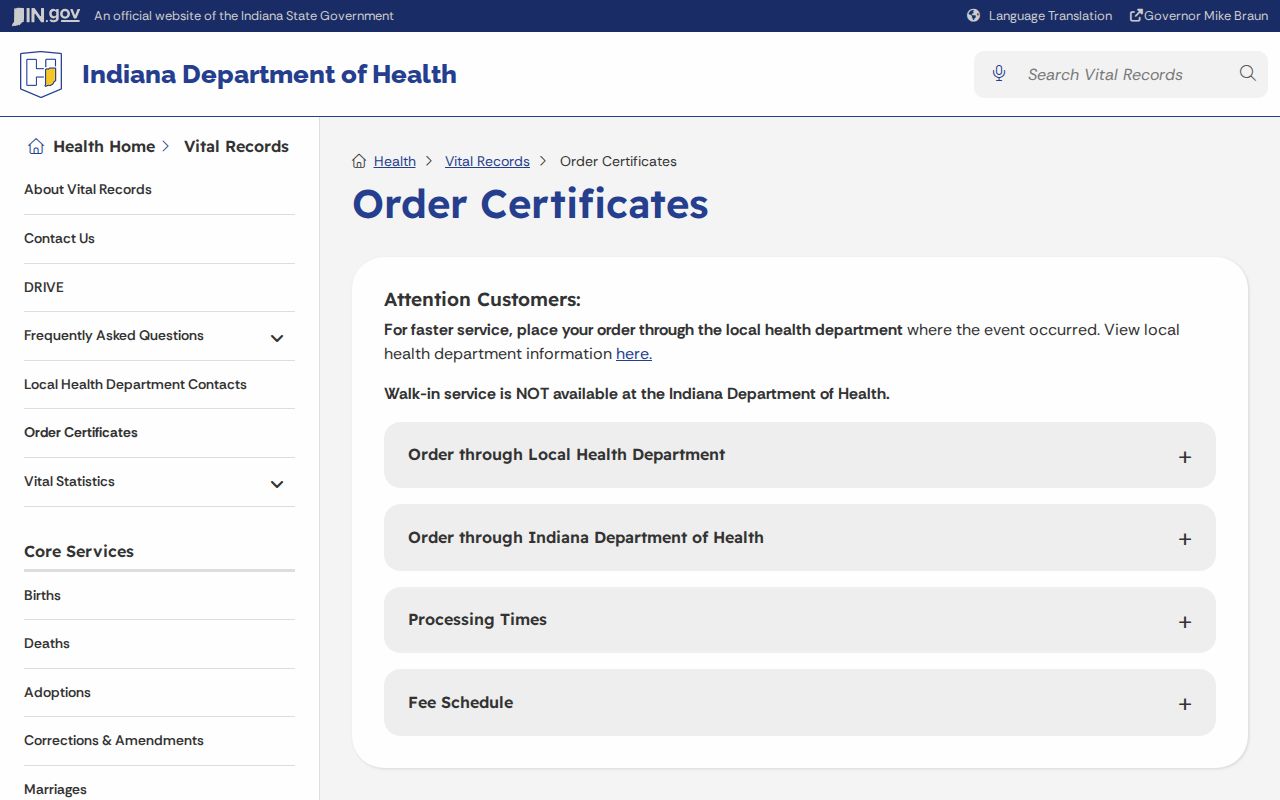
Use a death date as a probate clue, then require a recorded land transfer.
Local LaPorte Vital Record Access
The local health source below documents the county route.

Birth and death files remain subject to access rules and do not establish title.
How Far Back LaPorte County Ownership Records Go
LaPorte County was created in 1832. Pushing the oldest ownership chain that far back may require early county indexes, deed books, federal land-patent context, historic maps, and repository help. LPCPL's Indiana Room and the county Historical Society add directories, atlases, newspapers, plats, and research assistance. Those sources can explain an old address or owner. The deed chain itself still needs instrument-level support.
Lawful use. Trace prior owners for title, estate, and house-history research. Do not use historical or current details to track, harass, or harm a living person.